
Summarize Cases Automatically
Generate structured case briefs with sentiment tracking from every comment and email using GPTfy's Data Context Mapping
Last updated:
See AI summarize Salesforce cases automatically on every interaction
Structured case briefs with sentiment, tracking, and email history, generated from CRM data. 2-minute demo.
Agents write summaries. Customers wait.
Every case interaction forces agents to re-read the full thread before responding. Context gets lost, customers repeat themselves, and resolution times climb.
Per case spent writing manual summaries
Agents scroll through dozens of case comments, emails, and internal notes to piece together what happened. Critical details like promised callbacks and escalation history get buried in the thread.
“It enables Salesforce professionals like me to leverage AI of my choice in a declarative manner. Case summarization, classification, routing, personalized email response generation.”
- Sury Ramamurthy, Technical Architect, Innolake Corporation
Build prompts with Prompt BuilderEscalation delays from re-reading threads
When cases escalate, the receiving agent starts from scratch - re-reading the entire comment history to understand context. This doubles or triples the time to first meaningful response after handoff.
“Finally an easy to use AI solution which would not only help you manage daily tasks efficiently but also give you the power to interpret large datasets to make business decisions effectively.”
- Ashwin Kotian, AVP, ICICI Lombard
Connect your model via BYOM ArchitectureNo record of what the AI saw or produced
Most AI integrations produce summaries with no log of the input data, prompt used, or output generated. When compliance asks what data was sent to the model, teams have no answer.
“Found the deployment to be easy. Just took me 10 minutes. Pre-configured prompts and the complimentary Open AI connection helped me test this App quick.”
- Salman Khan, Release Manager, IBM
Secure this with Security LayerInstant Case Intelligence
Stop reading case histories manually
Agents joining an active case must scroll through dozens of comments, emails, and internal notes to understand what happened. This manual review takes five or more minutes per case, and critical details (like a customer's escalation history or a promised callback) get buried in the thread.
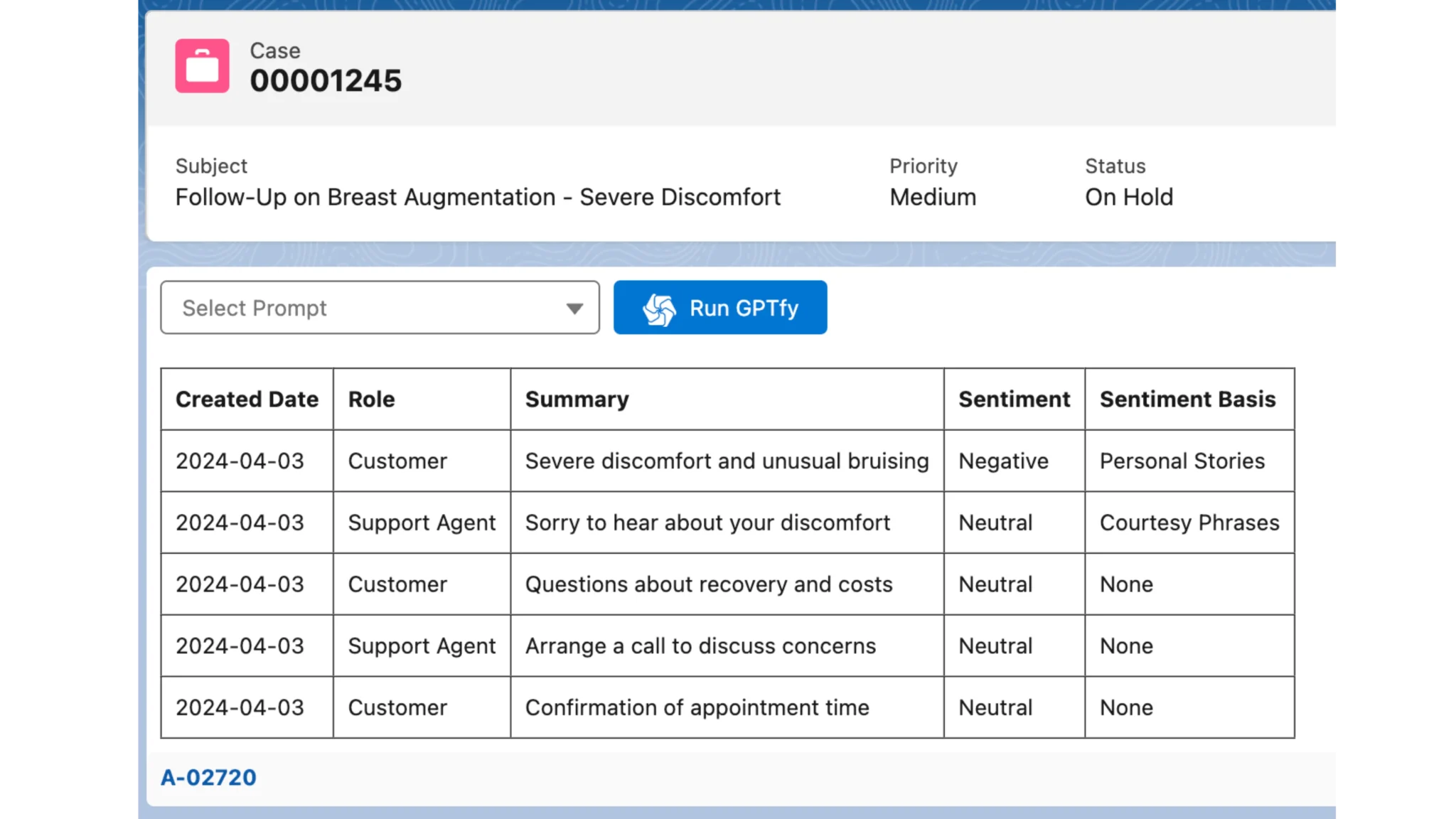
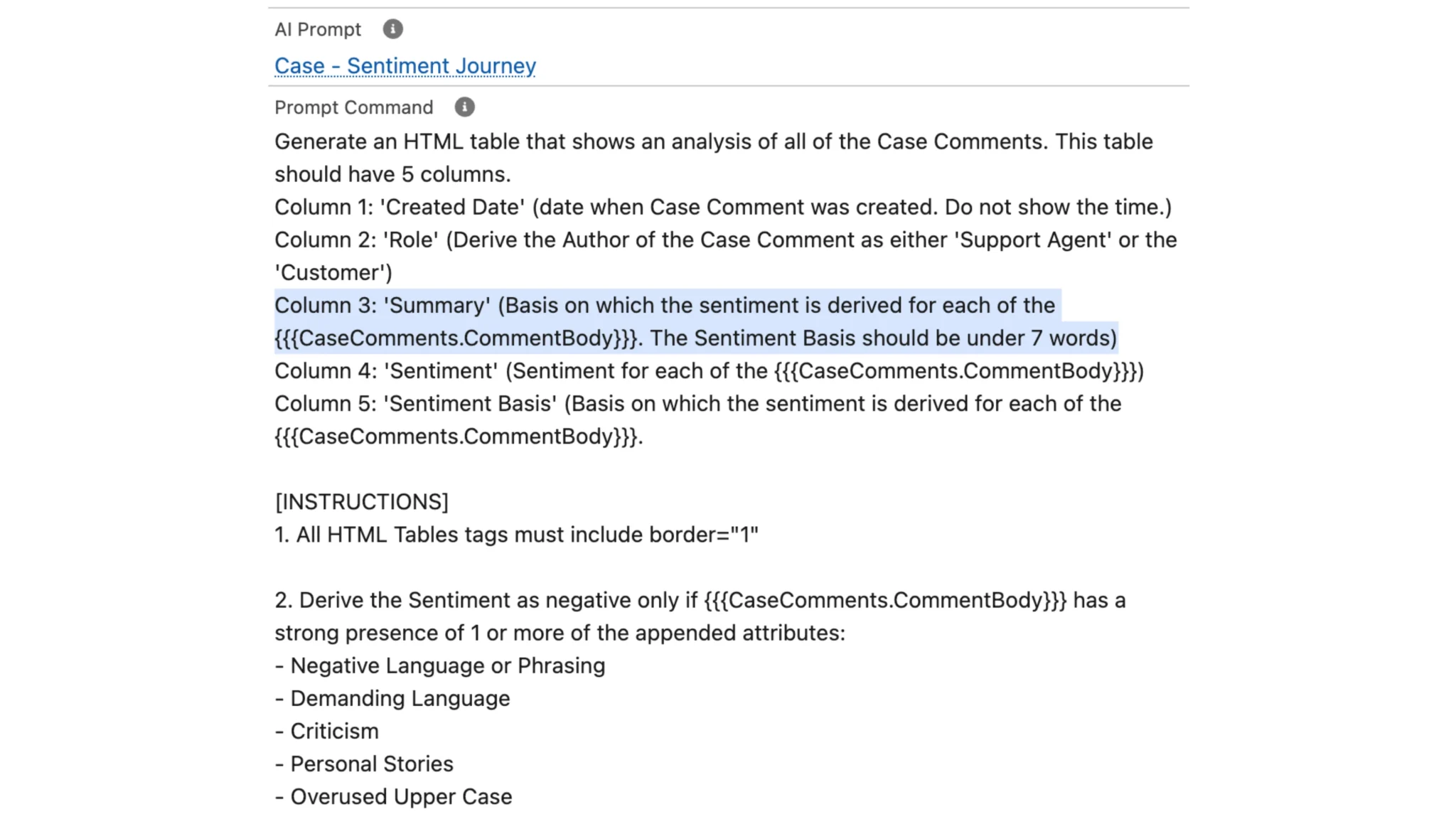
Sentiment journey analysis with AI
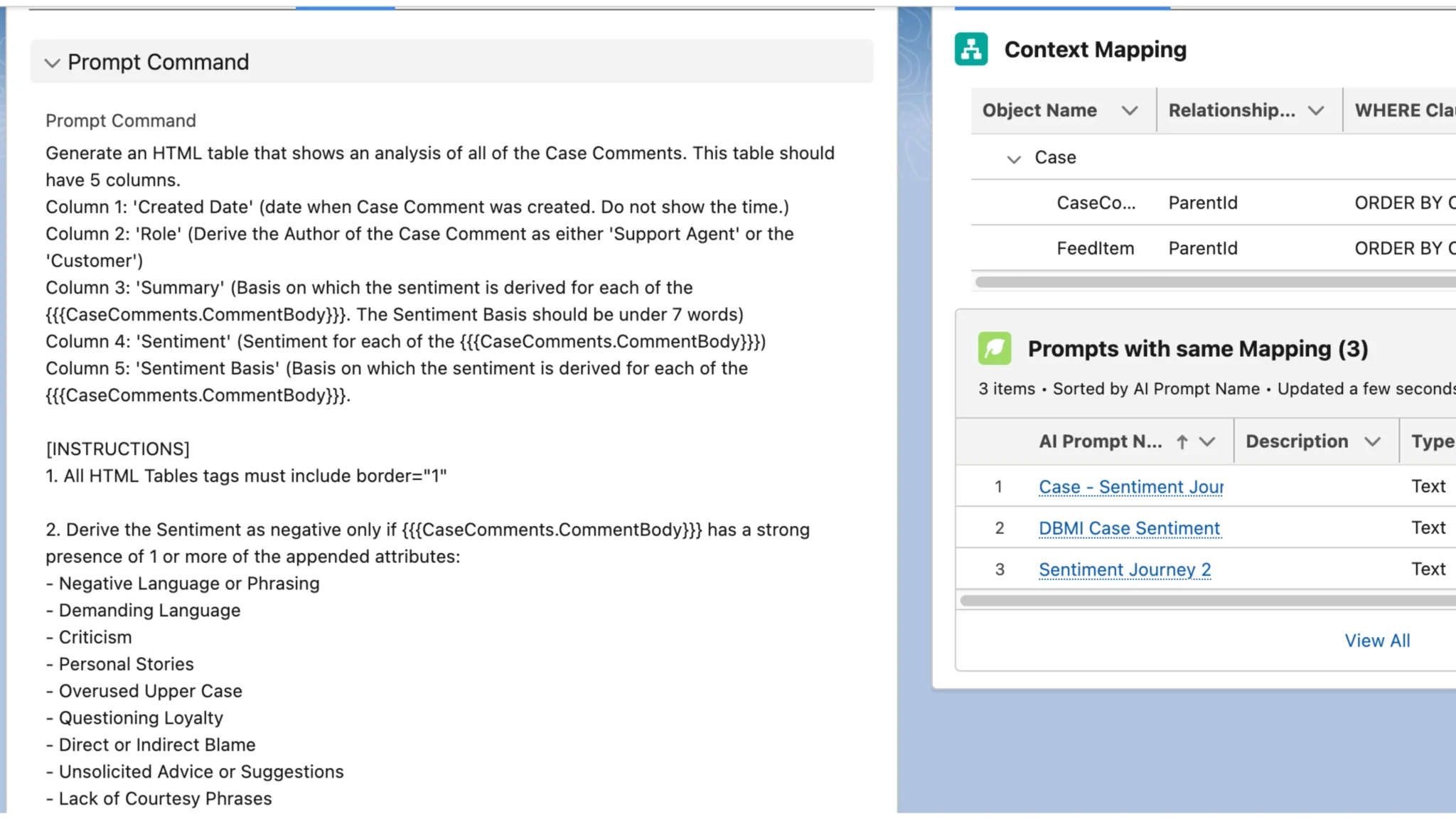
GPTfy's Data Context Mapping pulls case comments, email messages, and task records into a single AI prompt. The model generates a structured summary with timeline, key issues, sentiment trajectory, and recommended next steps, all visible on the case record page in under ten seconds.
Secure AI Analysis
Your data never leaves your infrastructure
GPTfy's PII masking engine automatically detects and strips customer names, emails, phone numbers, and account numbers before any data is sent to the AI model. All processing flows through Salesforce Named Credentials, keeping sensitive case data within your security perimeter.
Choose your preferred AI model
Connect to Azure OpenAI, Anthropic Claude, Google Gemini, or any OpenAI-compatible endpoint through GPTfy's AI Connection configuration. Assign different models per case type: use a fast model for simple summaries and a more capable model for complex escalations.
Proactive Customer Experience
End frustrated customer call repetition
When agents open a case and immediately reference the customer's previous interactions, promised timelines, and outstanding issues, the customer feels heard from the first sentence. This eliminates the frustrating 'can you explain your issue again' pattern that drives negative CSAT scores.
Improve first-call resolution rates
With a complete case summary showing issue timeline, attempted resolutions, and customer sentiment trajectory, agents arrive at the right solution faster. GPTfy's structured output highlights unresolved action items and suggests resolution paths based on the full case history.
Why Choose Case Summarization
Faster Case Resolution
AI-generated summaries give agents a complete picture in seconds instead of the five-plus minutes spent scrolling through comment threads, emails, and internal notes.
Reduced Escalation Time
Structured summaries with timeline, sentiment, and key issues let tier-two agents skip the re-read and jump straight to resolution - cutting escalation handoff time significantly.
Better Agent Productivity
Agents handle more cases per shift when they spend less time on manual summarization. Structured next-step recommendations keep every interaction focused and actionable.
Powerful Capabilities
Auto-Generated Summaries
GPTfy reads case comments, emails, and tasks, then produces a structured brief with issue timeline, key stakeholders, sentiment trajectory, and recommended next steps.
Multi-Object Data Pull
Data Context Mapping pulls from CaseComment, EmailMessage, Task, and any custom child objects into a single AI prompt - no manual record hopping required.
PII Masking
The Security Layer strips customer names, emails, phone numbers, and account numbers before data reaches the AI model, keeping sensitive case data within your security perimeter.
Audit Trails
Every AI prompt execution is logged in AI_Response__c with full input/output, token usage, and execution time - ready for compliance review at any point.
Key Takeaways
- Data Context Mapping pulls CaseComment, EmailMessage, and Task into a single AI prompt
- Generates structured summaries with timeline, key issues, and sentiment trajectory
- PII masking strips customer names and account numbers before data reaches the model
- AI Connection supports assigning different models per case type or complexity level
- Every prompt execution is logged in AI_Response__c with full input/output traceability
Frequently Asked Questions
GPTfy uses Data Context Mapping to pull case comments, email messages, tasks, and related records into a single AI prompt. The AI model then generates a structured summary with timeline, key issues, sentiment analysis, and recommended next steps, all displayed directly on the case record page.
Yes. GPTfy's PII masking engine strips customer names, emails, phone numbers, and account numbers before any data reaches the AI model. All API calls flow through Salesforce Named Credentials, keeping sensitive case data within your org's Security Layer.
Absolutely. GPTfy's AI Connection framework lets you assign different models per case type or complexity level. Use a fast model for routine summaries and a more capable model for complex escalations, all configurable through the managed package without code changes.
GPTfy generates a complete structured case summary in under ten seconds. This includes the issue timeline, sentiment trajectory, key stakeholders involved, and recommended next steps, replacing the five-plus minutes agents typically spend reading through case histories manually.
Yes. GPTfy's Data Context Mapping assembles case comments, emails, and tasks into a structured AI prompt regardless of thread length. For very large cases, the AI prioritizes the most relevant interactions and surfaces key decision points, escalation events, and resolution attempts in the summary.
GPTfy is a Salesforce-native managed package that inherits your org's security model. PII masking strips sensitive data before it reaches any AI model, and every prompt execution is logged in a Security Audit Record with full input-output traceability. These controls support HIPAA, GDPR, and SOC 2 compliance requirements.
See Case Summaries Generated Live
Watch GPTfy generate structured case briefs with sentiment analysis from your actual Salesforce case data in a live demo.