
Your AI Contract. Finally Earning Its Keep.
GPTfy lets Salesforce teams bring their own AI model — OpenAI, Anthropic Claude, Google Gemini, DeepSeek, Llama, Grok, and more — and run it natively inside your Salesforce org, with no Data 360 requirement and fixed per-user pricing. You already pay for OpenAI, Claude, or Gemini. As the Salesforce-native alternative to Agentforce, GPTfy puts them to work inside your org in 60 minutes, with no Data 360.
Last updated:
80%+of AI projects fail to reach production, twice the failure rate of non-AI IT projects (RAND Corporation, 2024)
See OpenAI, Claude, and Gemini running inside your Salesforce in 2 minutes
BYOM: bring any AI model to Salesforce through Named Credentials. No new infrastructure, no additional licensing.
Enterprise AI Contracts. Collecting Dust.
Your AI project becomes a dev project
Every use case needs custom Apex callouts, authentication management, and development cycles. Three months in, your team is still debugging the OpenAI integration.
Consumption credits scale against you
The pilot looks affordable at 4% usage. But when 200 users click that button 50 times a day, your CFO cannot budget it and your ops team starts throttling adoption.
Enterprise AI contracts wasted inside your CRM
You negotiated enterprise pricing with OpenAI or Azure, but cannot use it in your CRM without custom code. Every new model requires rebuilding the integration layer.





Evaluating the cost of switching models?
See cost savings vs BYOMArchitects, Connect in Minutes
Connect Your AI Model Provider via Named Credentials
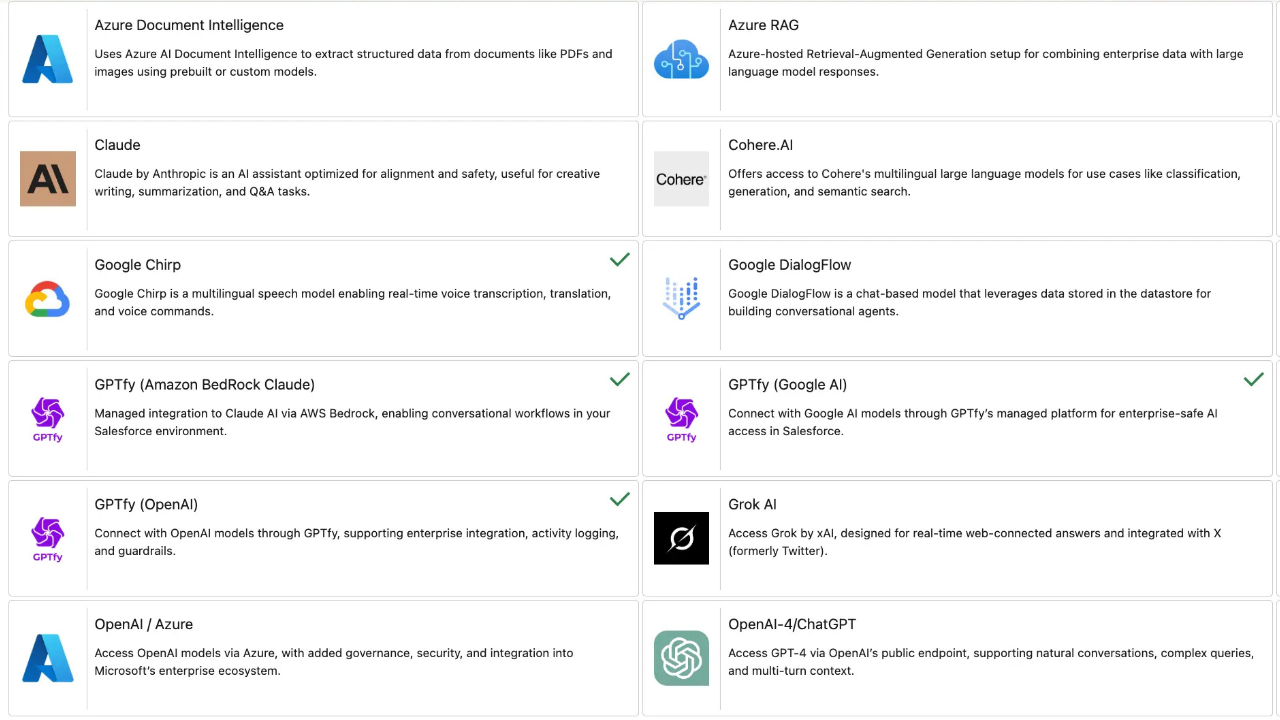
Connect OpenAI, Claude, Vertex AI, or Azure in minutes with no Apex. See the DeepSeek setup demo .
4-Layer Security Through the Security Layer
Named Credentials store API keys. 4-layer PII masking via the Security Layer protects every interaction automatically.
Security Leaders, Verify Everything
PII Masking via Security Layer Before Every AI Call
PII, PHI, and financial data are masked before any API callout. Verify every interaction in the audit trail .
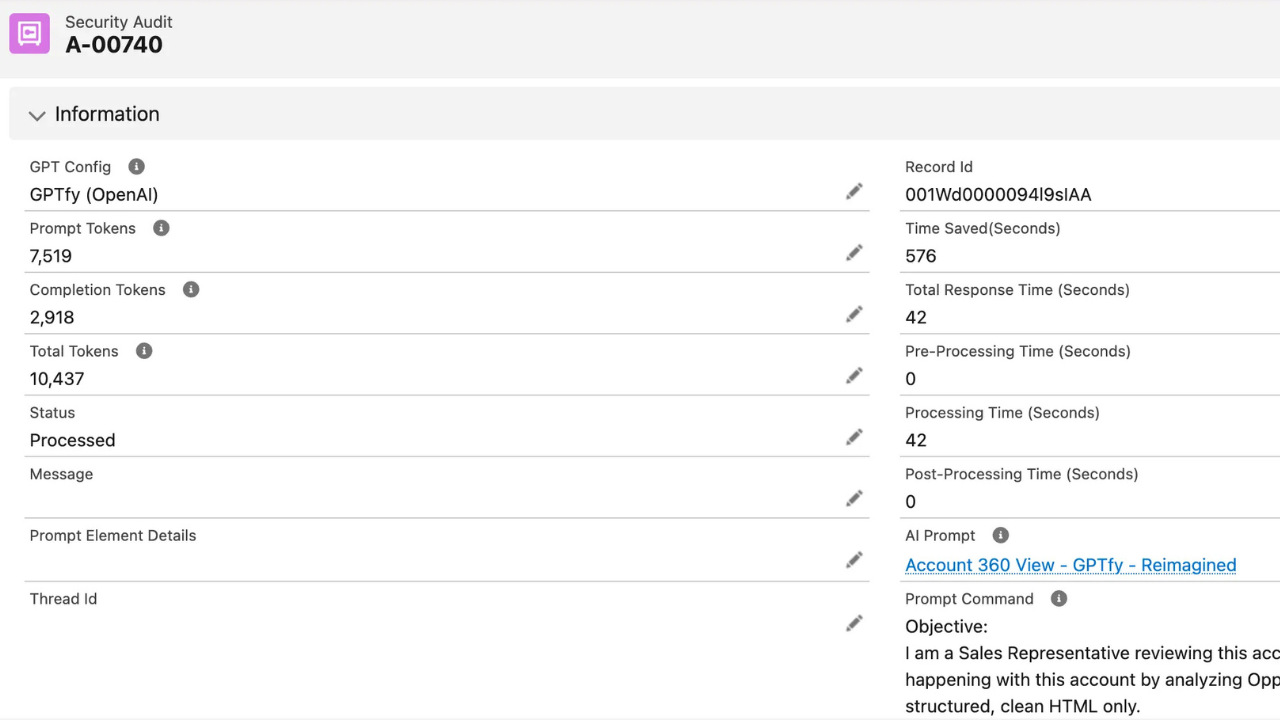
Full Audit Trail via AI_Response__c Records
Every execution is logged with model, token count, and timestamp. See prompt management in action .
IT Admins, Control Costs
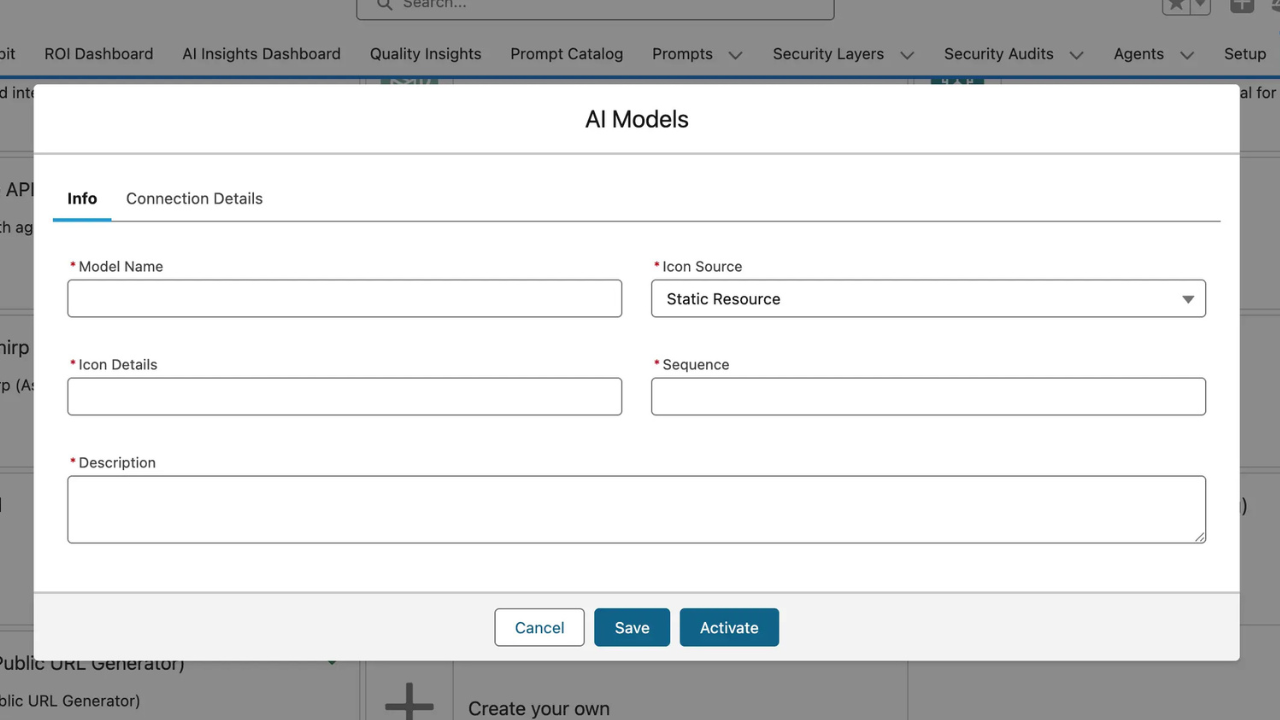
No-Code AI Connection Setup via the Cockpit
Create AI Connections with your API key and endpoint, no Apex needed. Then build prompts via the Prompt Builder .
Track Usage and Costs via the Analytics Dashboard
Monitor token usage, costs, and errors per connection. $20/user/month flat pricing. Watch the Llama setup demo .
Why Choose Bring Your Own Model
100% Data Control
Keep sensitive information within your security boundary with direct connections to AI providers. 4-layer masking protects every interaction.
Use Your Existing AI Contracts
Connect your enterprise OpenAI, Azure, or GCP agreements directly. Fixed $20/user/month pricing. No consumption credits. No per-prompt billing.
Switch Models Without Rebuilding
Use OpenAI for content generation, Claude for analysis, and Gemini for industry tasks. Switch models in minutes, not sprints.
Powerful Capabilities
15+ Models Supported
Connect OpenAI, Claude, Gemini, DeepSeek, Llama, and more. See the DeepSeek demo.
60-Minute Setup
Go live in 60 minutes with point-and-click configuration. No Apex development, no additional platform dependencies.
Usage Analytics Dashboard
Monitor token usage, costs, and performance per AI Connection. Set limits and alerts to control spend.
No Consumption Credits
100% native to your CRM. No per-prompt credit charges, no additional platform licenses, no separate cloud services required.
Key Takeaways
- Connect any AI model - OpenAI, Claude, Gemini, DeepSeek, Llama, Grok, Perplexity - through Salesforce Named Credentials.
- Raw data never leaves your infrastructure. Only PII-masked data reaches the AI provider via the GPTfy Security Layer.
- Route different prompts to different models: use GPT-4o for summarization, Claude for long-context analysis, DeepSeek for cost-sensitive tasks.
- No external servers. GPTfy runs as a Salesforce-native managed package installed from AppExchange.
- Per-model cost tracking, token usage dashboards, and audit trails for every AI call.
Frequently Asked Questions
GPTfy supports 15+ AI models including OpenAI, Anthropic Claude, Google Vertex AI, Azure OpenAI, DeepSeek, Perplexity, Llama, and Grok. You can connect any compatible LLM without code changes, using different models for specific use cases based on performance and cost.
Create an AI Connection record in GPTfy's managed package with your API key, endpoint URL, and model name. GPTfy handles authentication via Named Credentials. No Apex development, no additional platform dependencies. Most teams are running their first prompt within an hour.
GPTfy's 4-layer Security Layer masks PII, PHI, and financial data before any AI callout. Field-level, regex, blocklist, and Apex handlers protect every interaction. Every prompt execution is logged in AI_Response__c records with full audit trails for compliance reporting.
Fixed $20/user/month pricing with unlimited prompts. No consumption billing, no per-prompt credit overages. Use your existing enterprise AI contracts and negotiated rates. The analytics dashboard tracks token usage and costs per connection so you can optimize spend across models.
Yes. GPTfy Agents let you define routing logic so different prompts use different models. Use OpenAI for content generation, Claude for long-context analysis, and DeepSeek for cost-sensitive tasks. Switch or add models at any time without rebuilding your Salesforce workflows.
Yes. GPTfy is a Salesforce-native managed package installed from AppExchange. It integrates with your org's Named Credentials, role-based access controls, and data visibility rules. No external servers, no data leaves your infrastructure, and all AI interactions are logged in your audit trail.
No. GPTfy runs bring-your-own-model entirely inside your existing Salesforce org and does not require Data 360 (formerly Data Cloud) or Agentforce. It installs from AppExchange as a managed package and connects to your AI provider through Named Credentials.
GPTfy is a Salesforce-native managed package that runs inside your existing org and connects the AI model you already use — OpenAI, Anthropic Claude, Google Gemini, DeepSeek, Llama, Grok, and more — under fixed per-user pricing, with no Data 360 required. Models can be switched per use case without rebuilding your prompts or flows, and it works alongside your existing Salesforce AI investments.
See Your AI Model Run Live
We configure an AI Connection to your OpenAI, Claude, or Azure account, then execute a prompt using your model. All in 30 minutes with your org. You keep the configuration.
Explore More Features
OpenAI in Salesforce
Deploy GPT-5.2 in Salesforce through GPTfy with Named Credential architecture and full PII masking.
Google Gemini in Salesforce
Deploy Google Gemini using your existing Vertex AI project. GCP IAM policies apply, raw data stays in Salesforce.
Claude in Salesforce
Deploy Anthropic Claude with 200K context window for full Account histories, Case threads, and Opportunity timelines.
DeepSeek in Salesforce
Deploy DeepSeek R1 for chain-of-thought reasoning at 5-10x lower cost than GPT-4o. Same PII masking and audit trails.
Perplexity in Salesforce
Pull real-time web intelligence into Account, Lead, and Opportunity records. PII masked, every request audited.
Grok AI in Salesforce
Combine real-time social intelligence from X with your CRM data. PII masked, Named Credential security, full audit trail.
Llama in Salesforce
Deploy Meta Llama on your own infrastructure. Data never leaves your infrastructure. Full PII masking and audit trails.
Demo: DeepSeek in Salesforce
Watch DeepSeek model setup and execution in Salesforce
Demo: Llama in Salesforce
See Llama model connected and running AI prompts
Security Trust Layer
PII masking, audit trails, and access controls for every AI call
GPTfy vs Other AI Clouds
Compare architecture, pricing, and security across Salesforce AI options.
RAG for Salesforce
Ground AI responses in your Knowledge articles via vector search
What is a named credential for AI?
The secure way to connect AI models to Salesforce.