
BYOM vs Einstein AI: Salesforce AI Model Comparison
Connect any LLM to Salesforce with BYOM, or rely on Einstein AI's native model. Understand the trade-offs in architecture, cost, data residency, and compliance before you commit.
Last updated:
What Is BYOM in Salesforce?
BYOM — Bring Your Own Model — is an AI integration pattern where organizations connect their preferred large language model (LLM) directly to Salesforce rather than relying exclusively on the AI models provided by Salesforce. In practice, BYOM means your Salesforce org makes authenticated callouts to an external AI endpoint of your choosing, passing CRM data as context and receiving AI-generated output in return.
GPTfy, available on AppExchange, is the leading BYOM platform for Salesforce. It provides a managed package that abstracts the complexity of AI integration behind a declarative configuration layer, so admins can connect AI models without writing authentication code or managing HTTP callouts manually.
How BYOM Works Technically
In GPTfy's BYOM architecture, each AI model is registered as an AI Model record in the GPTfy Cockpit. The record specifies the provider (Azure OpenAI, AWS Bedrock, Google Vertex AI, or a custom endpoint), the Named Credential used for authentication, and model parameters like temperature and token limits.
Salesforce Named Credentials are the security mechanism that makes BYOM enterprise-safe. They store API keys and authentication tokens in Salesforce's encrypted credential store — never in code, configuration files, or version control. When a GPTfy prompt runs, Salesforce resolves the Named Credential at callout time, ensuring API keys are never exposed in logs or developer consoles.
Supported BYOM Providers
- Azure OpenAI: GPT-4o, GPT-4o Mini, GPT-4 Turbo. Supports regional deployment for data residency compliance. Recommended for organizations in Microsoft-heavy environments or those requiring EU/US data separation.
- AWS Bedrock: Anthropic Claude 3 (Haiku, Sonnet, Opus), Llama 3, Mistral, and other Bedrock-hosted models. Ideal for AWS-native organizations or those with existing Bedrock commitments.
- Google Vertex AI / Gemini: Gemini Pro, Gemini Ultra. Strong multimodal capabilities for document-heavy use cases. Integrates with Google Cloud infrastructure.
- DeepSeek: DeepSeek-V3 and DeepSeek-R1. Strong analytical reasoning at a competitive price point. Available via DeepSeek's API or self-hosted.
- Llama (Meta): Open-source models available through AWS Bedrock, Azure AI, or self-hosted infrastructure. Useful for organizations with strict data residency requirements that want to run models in their own cloud environment.
- Custom / On-Premise Models: Any model accessible via a REST API endpoint. GPTfy supports custom Connector Classes (Apex interfaces) for non-standard authentication flows, enabling integration with internally hosted or fine-tuned models.
What BYOM Is Not
BYOM is not simply "connecting to an API." Without a platform like GPTfy, you would need to write Apex HTTP callout classes, handle token management, build prompt templates, map CRM data into payloads, and process structured JSON responses — all manually. GPTfy's BYOM framework handles all of this declaratively, making it a configuration exercise rather than a development project for most use cases.
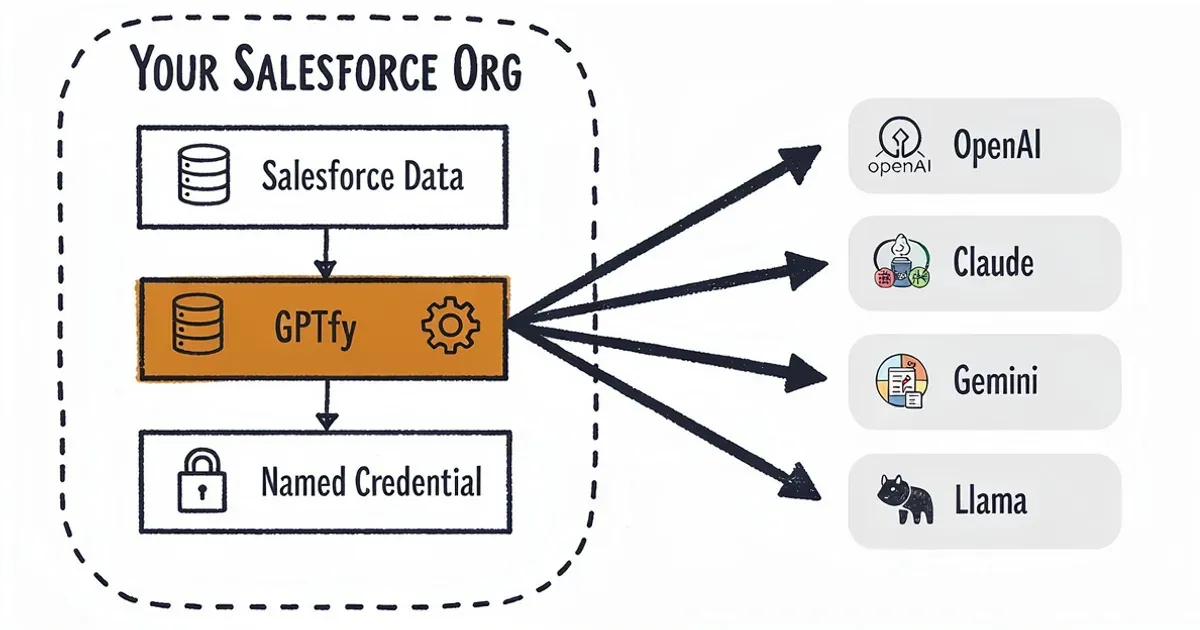
BYOM data flow: Salesforce → GPTfy Data Context Mapping → Named Credential → External LLM endpoint
What Is Einstein AI in Salesforce?
Einstein AI is Salesforce's suite of artificial intelligence capabilities built natively into the Salesforce platform. It encompasses Einstein Prediction Builder, Einstein Discovery, Einstein Language, Einstein Vision, and — most relevant to this comparison — the generative AI capabilities that power Einstein Copilot, Agentforce, and Einstein for Sales and Service.
The generative AI layer of Einstein operates through the Einstein Trust Layer, a security and routing architecture that sits between Salesforce and external AI model providers. As of 2025, Einstein's generative capabilities primarily use OpenAI models (GPT-4 and GPT-4o) routed through Salesforce's Einstein Platform Services infrastructure.
The Einstein Trust Layer
The Einstein Trust Layer is Salesforce's answer to enterprise AI governance. It provides:
- Zero data retention: Salesforce contractually guarantees AI providers will not store or train on your Salesforce data when routed through the Trust Layer.
- Prompt defense: Heuristic filters that detect and mitigate prompt injection attempts.
- Toxicity detection: Scanning for harmful content in both prompts and responses.
- PII masking: Basic PII detection before data reaches the AI model.
- Audit logging: Interaction records accessible through Einstein's monitoring tools.
Agentforce and the Einstein Model Strategy
Agentforce (launched in late 2024) is Salesforce's agentic AI platform built on the Atlas reasoning engine. It represents the most advanced expression of Einstein AI today. Agentforce uses Einstein-hosted models for reasoning and action planning, with Data 360 providing the grounding layer that connects agent responses to real customer data.
Model flexibility within Einstein is limited. Salesforce controls the model selection, and customers cannot freely swap to a different provider. Some customization is available through Model Builder (Einstein Studio), which allows connecting external models, but this is constrained compared to full BYOM flexibility.
Einstein AI: Right-Sized for What?
Einstein AI shines in scenarios where deep Salesforce platform integration is the primary requirement — pre-built predictions, declarative automation triggered by AI signals, and native UI components that surface Einstein insights without any custom development. For organizations that need more model control, cost transparency, or regulatory compliance around data routing, Einstein's closed-model approach becomes a constraint.
Architecture Comparison: BYOM vs Einstein
Understanding the architectural differences between BYOM (via GPTfy) and Einstein AI helps clarify which approach fits which organizational need. Both operate within Salesforce, but they route data, manage models, and structure outputs very differently.
Data Flow: BYOM (GPTfy)
- A Salesforce trigger, Flow, or user action initiates a GPTfy prompt.
- GPTfy's Data Context Mapping fetches relevant Salesforce records (up to three object levels) and assembles the prompt payload.
- The masking layer (Layers 1-4) anonymizes PII fields before the payload leaves Salesforce.
- Salesforce makes an authenticated callout via Named Credential to the configured AI endpoint (Azure OpenAI, Bedrock, Vertex AI, etc.).
- The AI model processes the prompt and returns a response — structured JSON or natural language.
- GPTfy's Response Mapping Framework parses the response and writes values back to Salesforce fields.
- A Security Audit record captures the full interaction — original payload, masked payload, PII key, response — for compliance review.
Data Flow: Einstein / Agentforce
- A Salesforce trigger, Flow, or user interaction initiates an Einstein request.
- Data 360 unifies relevant customer data into a profile (for Agentforce; required for grounding).
- The request passes through the Einstein Trust Layer for prompt defense and PII masking.
- The Trust Layer routes the request to the Einstein Platform Services infrastructure (Salesforce-controlled).
- The AI model (OpenAI GPT-4 or similar, as selected by Salesforce) processes the request.
- The response is returned through the Trust Layer (toxicity check) to the Salesforce UI or automation.
Key Architectural Differences
- Model control: BYOM — you choose the model per prompt. Einstein — Salesforce chooses, with limited customer override.
- Data residency: BYOM — your Named Credential determines the endpoint region. Einstein — data routes through Salesforce infrastructure in Trust Layer-approved regions.
- Grounding data: BYOM via GPTfy — Data Context Mapping fetches live Salesforce records. Agentforce — requires Data 360 for unified customer profiles.
- Audit records: BYOM via GPTfy — dedicated Security Audit custom objects with full payload capture, queryable via SOQL. Einstein — interaction logs via Einstein monitoring tools, less granular.
- Installation footprint: BYOM via GPTfy — AppExchange managed package, no extra Salesforce SKUs. Einstein/Agentforce — requires Einstein Platform license; Agentforce with full grounding requires Data 360.
Supported Models: BYOM vs Einstein
Model availability is one of the starkest differences between the BYOM approach and Einstein AI. The following comparison reflects the state as of early 2026.
Models Available via BYOM (GPTfy)
- OpenAI (via Azure or direct): GPT-4o, GPT-4o Mini, GPT-4 Turbo, GPT-3.5 Turbo. Azure deployment enables region-specific hosting for EU data residency.
- Anthropic Claude (via AWS Bedrock or direct): Claude 3 Haiku, Claude 3 Sonnet, Claude 3 Opus, Claude 3.5 Sonnet. Excels at long-context analysis, instruction following, and compliance-sensitive tasks.
- Google Gemini (via Vertex AI): Gemini 1.5 Pro, Gemini 1.5 Flash. Strong multimodal capabilities; useful for document analysis and code generation.
- Meta Llama (via Bedrock or self-hosted): Llama 3 8B, 70B, 405B. Open-weight models that can be deployed in private cloud infrastructure for maximum data control.
- DeepSeek: DeepSeek-V3, DeepSeek-R1. Competitive analytical and coding capabilities at significantly lower per-token cost than frontier models.
- Perplexity: Perplexity Sonar for real-time web-grounded research; useful for competitive intelligence and financial analysis prompts.
- Custom / fine-tuned models: Any model behind a REST endpoint, including internally trained models, industry-specific fine-tunes, or models from providers not listed above.
Models Available via Einstein AI
- Einstein-hosted OpenAI models: GPT-4o and related OpenAI models routed through the Einstein Trust Layer. Specific model versions and updates are managed by Salesforce.
- Einstein Studio (Model Builder): Allows connecting external models from Anthropic, Amazon, Google, and others, but with more configuration complexity and limitations on which capabilities can use external models.
Prompt-Level Model Selection: A BYOM Exclusive
One capability unique to GPTfy's BYOM implementation is prompt-level model selection. In GPTfy, every individual prompt can point to a different AI model. This enables cost-optimized architectures where:
- High-volume, low-complexity prompts (case summaries, email drafts) run on fast, inexpensive models like GPT-4o Mini or Claude Haiku.
- Low-volume, high-complexity prompts (deal scoring, financial analysis, compliance reviews) run on premium reasoning models like GPT-4o or Claude Opus.
- Compliance-sensitive prompts route to region-specific endpoints to satisfy data residency requirements.
Einstein AI does not offer prompt-level model selection — the model is determined by Salesforce's routing logic, not the customer's per-task optimization strategy.
Cost Comparison: BYOM vs Einstein AI
Total cost of ownership for AI in Salesforce involves more than the AI provider's per-token rates. Platform licensing, data infrastructure, and usage scaling all contribute to the final number. Here is how BYOM and Einstein compare across these dimensions.
BYOM (GPTfy) Cost Structure
- Platform license: GPTfy charges a fixed annual license fee. This is predictable regardless of how many prompts you run, how many conversations occur, or how many tokens are consumed.
- AI provider costs: You pay your AI provider (OpenAI, Anthropic, Google, AWS) directly at their published API rates. These are your costs to optimize — by choosing the right model per task, organizations routinely reduce AI spend by 40-70% versus using a single premium model for all tasks.
- Infrastructure: No Data 360 required. No additional Salesforce SKUs required. Works with any existing Salesforce edition.
Einstein / Agentforce Cost Structure
- Einstein Platform: Requires the Einstein Platform add-on for full generative AI capabilities. Pricing varies by Salesforce edition and negotiation.
- Agentforce per-conversation pricing: Agentforce charges per conversation (approximately $2/conversation as of 2025). For high-volume teams — service centers handling thousands of interactions daily — this scales significantly.
- Data 360: Agentforce's grounding capabilities require Data 360. Data 360 licensing is an additional purchase, typically $0.09-$0.25 per record per month depending on volume and edition.
- AI credits: Some Einstein capabilities consume AI credits, which are bundled or purchasable in packs. Credit exhaustion can interrupt AI functionality until replenished.
Cost Example: 100-Seat Sales Team
Consider a 100-seat sales team running AI prompts across Opportunities, Accounts, and Contacts — approximately 5,000 prompt executions per day.
- BYOM approach: Fixed GPTfy license (annual) + API costs at ~$0.002/1K tokens for a mid-tier model. Daily API cost estimate: $10-30. Annual total: GPTfy license + ~$4,000-11,000 in API costs. Fully predictable.
- Agentforce approach: If Agentforce interactions average 500/day at $2/conversation: $1,000/day, $365,000/year in conversation fees alone — before Einstein Platform and Data 360 licensing.
These numbers illustrate why organizations with high prompt volume or existing AI provider commitments frequently find BYOM more economical. Agentforce's per-conversation pricing model is designed for organizations with lower interaction volumes or those that have negotiated enterprise pricing.
Data Residency and Compliance
For organizations in regulated industries — healthcare, financial services, government, legal — data residency is not an option, it is a requirement. Both BYOM and Einstein AI address this, but through different mechanisms with different levels of customer control.
BYOM Data Residency Control
With BYOM, data residency is controlled by the Named Credential you configure. If you create a Named Credential pointing to an Azure OpenAI instance deployed in the West Europe region, your Salesforce data routes exclusively to that European endpoint. This gives customers direct, auditable control over where data is processed.
Common data residency configurations with BYOM:
- EU customer data → Azure OpenAI (West Europe) for GDPR compliance
- Healthcare data → AWS Bedrock in US-East for HIPAA-compliant Claude processing
- Classified or sensitive data → Self-hosted Llama instance in private cloud
- General business data → Standard OpenAI API for cost efficiency
Einstein Trust Layer Data Routing
Einstein AI routes data through Salesforce's Einstein Platform Services infrastructure. Salesforce contractually guarantees zero data retention (AI providers do not train on your data) and routes within approved geographic regions. However, the specific routing is controlled by Salesforce, not the customer. You cannot, for example, mandate that all European customer data routes to an EU-based endpoint — Salesforce's routing handles this through their infrastructure.
Compliance Certifications
- GPTfy (BYOM): AppExchange Security Reviewed. Masks 16 of 18 HIPAA PHI identifiers via the four-layer masking architecture. Security Audit records provide SOQL-queryable audit trails for HIPAA, GDPR, and SOX compliance. Data masking occurs before the callout leaves Salesforce, so PII is never transmitted to the AI model.
- Einstein AI: Salesforce holds SOC 2, ISO 27001, and various regional certifications. The Einstein Trust Layer provides contractual data non-retention guarantees. The Einstein Trust Layer's PII masking is less granular than GPTfy's four-layer approach.
Implementation Complexity
- BYOM via GPTfy: Named Credential setup takes 30-60 minutes per provider. GPTfy includes pre-configured credentials for common providers. Declarative configuration, no custom Apex required for standard providers.
- Einstein AI: Requires enabling Einstein Platform features through Setup. Agentforce requires Data 360 provisioning. Einstein Studio (for external models) adds configuration complexity. Generally requires Salesforce Admin or Architect-level expertise.
When to Choose BYOM vs Einstein AI
Both BYOM and Einstein AI are legitimate approaches to Salesforce AI. The decision depends on your organization's existing investments, compliance requirements, AI strategy, and budget model.
Choose BYOM (GPTfy) When
- You want to use models you've already licensed (Azure OpenAI, AWS Bedrock, Google Vertex AI).
- You need to route data to specific geographic regions for GDPR, HIPAA, or sovereign cloud requirements.
- You want prompt-level model selection — different models for different task types.
- You need predictable, fixed-price AI platform licensing.
- You want comprehensive audit trails via Security Audit records with SOQL queryability.
- You do not have — or do not want to purchase — Data 360.
- You operate in a regulated industry requiring 4-layer PII masking (field-level, regex, blocklist, custom Apex).
- You want to integrate models that Salesforce does not offer (DeepSeek, Perplexity, fine-tuned models).
- You need REST API access to AI capabilities for external system integration.
Choose Einstein AI When
- You are already licensed for Einstein Platform and Data 360.
- You prefer a fully Salesforce-native solution with no third-party AppExchange package.
- Your use cases align with Einstein's pre-built predictions and Agentforce templates.
- Your interaction volume is moderate, making per-conversation pricing acceptable.
- You need deep integration with Salesforce's first-party features (Predictions, Scoring, Next Best Action).
- You want Salesforce to manage model updates and security without customer-side configuration.
Hybrid Approach: BYOM + Einstein Together
Many organizations use both. Einstein's native predictions (lead scoring, opportunity health) run on Einstein's proprietary ML models — GPTfy cannot replicate these. Meanwhile, GPTfy handles generative AI tasks (email drafts, case summaries, meeting notes, compliance analysis) with the model flexibility and audit depth that Einstein's generative layer cannot match. The two platforms complement rather than compete.
Key takeaways
BYOM Means Any Model, Any Provider
Bring Your Own Model lets Salesforce orgs connect GPT-4o, Claude 3, Gemini, Llama, DeepSeek, or any REST-accessible endpoint via Named Credentials — no Salesforce model lock-in.
Einstein AI Uses Salesforce-Hosted Models
Einstein AI (including Agentforce) primarily routes through Salesforce's Einstein Trust Layer using OpenAI-backed models. Custom model support is limited to what Salesforce approves.
Data Residency is Controlled by Your Named Credential
With BYOM, you choose which region your AI endpoint lives in. Send EU customer data to an Azure OpenAI instance in West Europe. Einstein AI routes through Salesforce's own infrastructure.
Cost Structure Differs Fundamentally
BYOM via GPTfy uses fixed annual licensing plus your own AI provider's API rates. Einstein and Agentforce charge per conversation or per AI credit, which scales unpredictably at volume.
No Data 360 Required for BYOM
GPTfy's BYOM implementation works with any Salesforce edition — Sales Cloud, Service Cloud, or a custom org. Full answer: [Does Agentforce require Data Cloud?](/does-agentforce-require-data-cloud/)
Prompt-Level Model Selection is Uniquely Possible with BYOM
GPTfy lets each individual prompt use a different model. Route case summaries to a fast, cheap model while sending deal analysis to a premium reasoning model — all from the same org.
FAQ
BYOM stands for Bring Your Own Model. In Salesforce, it refers to the ability to connect an external AI model — such as Azure OpenAI's GPT-4o, AWS Bedrock's Claude, Google Vertex AI's Gemini, DeepSeek, or Llama — to Salesforce instead of relying exclusively on Salesforce's built-in Einstein AI models. GPTfy on AppExchange is the leading platform for BYOM in Salesforce.
Yes. With GPTfy's BYOM feature, you can connect GPT-4o or GPT-4 Turbo to Salesforce via a Named Credential pointing to either the OpenAI API directly or an Azure OpenAI endpoint. Once configured, GPT-4 becomes available in the GPTfy Prompt Builder for any prompt, Flow invocation, or agentic task in your org.
BYOM (Bring Your Own Model) lets you connect any AI model you choose to Salesforce via authenticated API calls. Einstein AI uses Salesforce-hosted and Salesforce-managed models routed through the Einstein Trust Layer. BYOM via GPTfy gives you model choice, data residency control, and fixed-price licensing. Einstein AI offers native Salesforce integration and a Salesforce-managed security layer, but less flexibility in model selection.
No. GPTfy's BYOM implementation works with any Salesforce edition — Sales Cloud, Service Cloud, or a custom org — without requiring Data 360 (formerly Data Cloud) or any additional Salesforce SKU. GPTfy's Data Context Mapping fetches live Salesforce records as context for AI prompts without needing a unified data lake.
Full answer: [Does Agentforce require Data Cloud?](/does-agentforce-require-data-cloud/)
The standard approach is: (1) Install GPTfy from AppExchange. (2) Create a Named Credential in Salesforce Setup pointing to your AI provider's endpoint with the appropriate API key. (3) Create an AI Model record in the GPTfy Cockpit, selecting your Named Credential and configuring model parameters. (4) Activate the model. (5) Select it in the Prompt Builder when building prompts. GPTfy includes pre-configured Named Credentials for OpenAI, Azure OpenAI, and other common providers.
Yes, when implemented correctly. GPTfy's four-layer masking architecture anonymizes PII before any data leaves Salesforce: Layer 1 masks entire field values (email, phone, name), Layer 2 uses regex patterns to detect and mask PII within long text, Layer 3 uses blocklists for known sensitive terms, and Layer 4 executes custom Apex logic for complex scenarios. Only masked data reaches the AI model. Security Audit records capture the original data, masked data, and PII keys for audit purposes.
Yes. With GPTfy's BYOM, you can connect Anthropic Claude (via AWS Bedrock or the Anthropic API directly) and Google Gemini (via Google Vertex AI) to Salesforce. Each model is registered as a separate AI Model record. Individual prompts can be configured to use Claude, Gemini, or any other registered model — you can even use different models for different prompts within the same org.
The Einstein Trust Layer is Salesforce's AI governance architecture for generative AI. It sits between Salesforce and AI model providers, providing contractual data non-retention guarantees (AI providers don't train on your data), prompt defense against injection attacks, toxicity detection, and basic PII masking. It is the security foundation for Einstein Copilot, Agentforce, and other Salesforce generative AI features.
Connect Your AI Model to Salesforce in 30 Minutes
We'll demonstrate GPTfy's BYOM configuration live — Named Credential setup, model activation, prompt-level selection, and a live comparison of two models on the same Salesforce record.
Explore More
AI Data Masking in Salesforce
Four-layer PII masking architecture for HIPAA, GDPR, and SOX compliance.
RAG in Salesforce
Ground AI responses in Salesforce Knowledge with retrieval-augmented generation.
Agentic AI in Salesforce
How autonomous AI agents execute Salesforce operations vs generating text.
GPTfy Security Layer
Enterprise-grade PII masking and audit trails for AI in Salesforce.
GPTfy Pricing
Fixed-price licensing for Salesforce BYOM AI — no per-conversation fees.
AppExchange Listing
Install GPTfy managed package and connect your first AI model today.