
Sync Gmail Activity Into Salesforce
GPTfy Connect is an AI-native email sync adapter for Salesforce. It applies AI to determine business relevance before any email touches the CRM, with server-side Gmail sync, prompt-configurable content intelligence, and admin-controlled governance.
Last updated:
The CRM Activity Gap
Customer work happens in Gmail. CRM activity history is chronically incomplete. The consequences are predictable:
- Account and opportunity reviews miss key context from recent email threads and meeting cadence.
- Stakeholders sitting in CC/BCC lists never make it into Contacts or Leads.
- Forecasts and next-step decisions are built on partial activity history.
The answer isn't asking reps to log more manually. Sync activity automatically, matched to the right records, with the right access controls.
What Gmail-to-Salesforce Sync Actually Means
Gmail-to-Salesforce sync captures emails, Google Calendar events, and Google Tasks from Gmail/Google Workspace and associates them to Salesforce records so teams see the real customer timeline inside Salesforce, not a manually maintained subset of it.
The core challenge is not whether you can sync email. It's whether you sync the right activity to the right record, governed by the right security controls. Bulk email dumping into a CRM creates noise and compliance risk. Governed sync creates a complete, usable activity layer.
What GPTfy Connect Does
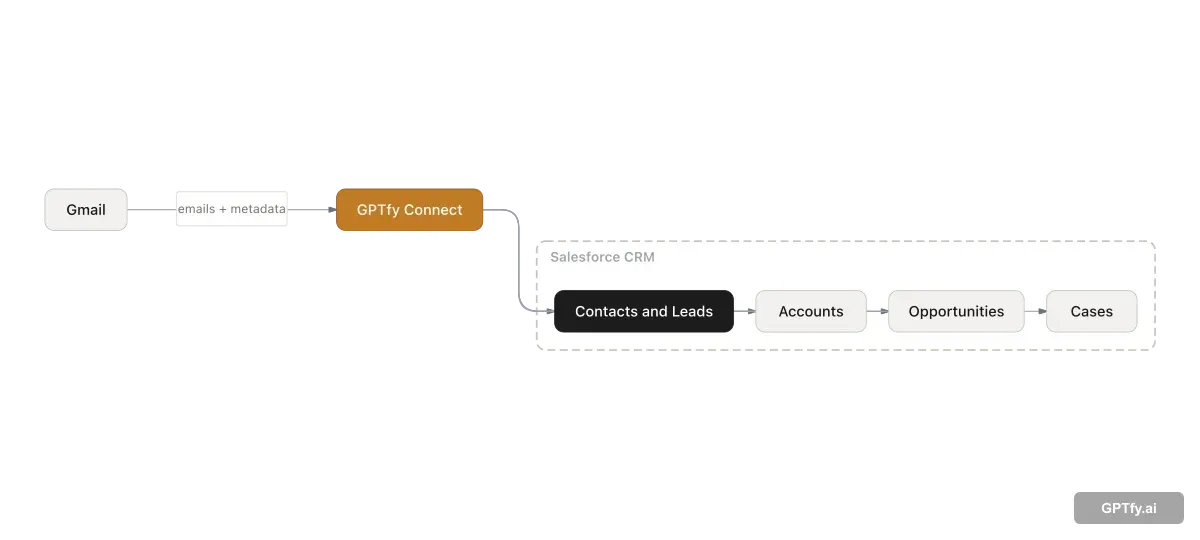
GPTfy Connect is a Salesforce-native, server-side sync capability that connects to Gmail and Google Workspace using the Gmail API and Google Calendar API, and syncs emails (inbound and outbound), Google Calendar events, and Google Tasks into Salesforce.
Because GPTfy Connect runs server-side inside Salesforce, there is no browser plugin to install, no client-side configuration to maintain, and no reliance on reps remembering to click a button. For a comparison with the Outlook implementation, see the Outlook sync guide .
Two Sync Modes
GPTfy Connect runs in two modes, which teams can use independently or together depending on how they want to work:
- Manual sync. The rep opens GPTfy Connect, reviews unsynced emails, calendar events, and tasks, and selects what to import. Each item shows its AI-suggested Salesforce association. Contact, Account, and Opportunity, which the rep confirms, adjusts, or skips before importing. This mode gives reps direct oversight of what enters the CRM and works well for logging specific conversations on demand.
- Automated sync. An admin configures sync in Salesforce, setting the run frequency, a lookback period (how far back in the mailbox to retrieve), and a maximum number of emails per run. Once active, sync runs in the background on schedule without rep involvement. Clear matches write to Salesforce automatically; low-confidence matches queue for human review without blocking the rest of the run.
AI-Native Sync: Content Intelligence Before Association
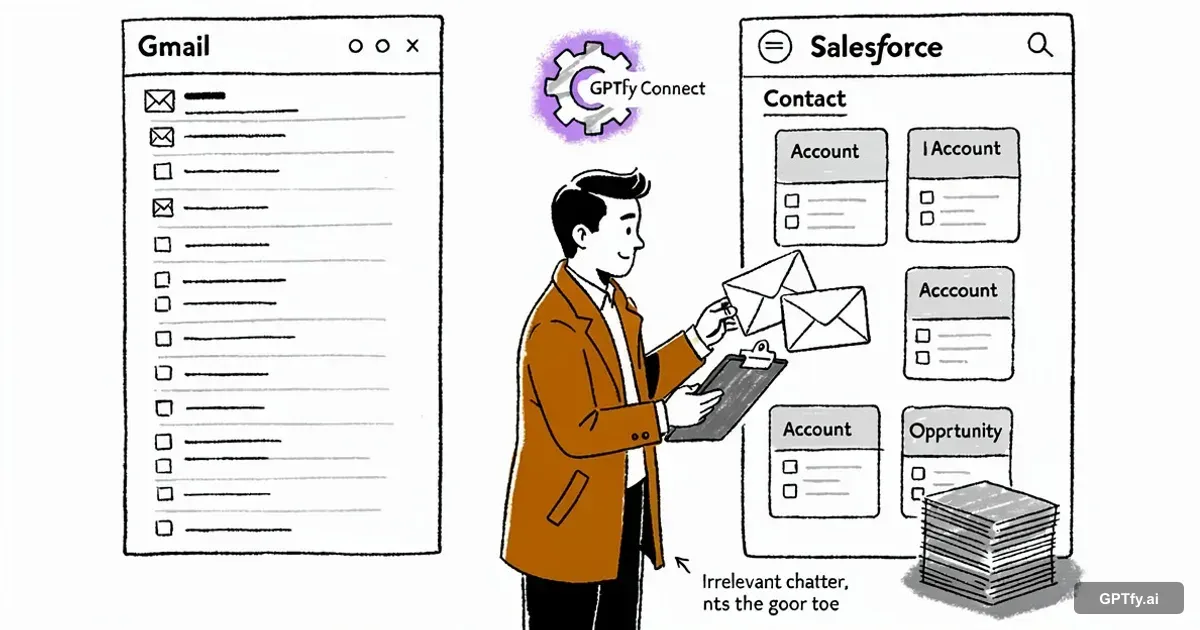
Most email sync tools use rules to decide what not to sync; domain exclusions, category filters, keyword blocklists. GPTfy takes a different approach: before any email is associated with a Salesforce record, AI reads the email content and determines whether it is business relevant at all.
This is what makes GPTfy Connect an AI-native email sync adapter, not a sync adapter with AI features added on top. The intelligence is built into the pipeline.
The Problem Rules Cannot Solve
Deterministic filters catch known patterns; internal domains, HR categories, newsletter subscriptions. They cannot catch emails that look legitimate but are not CRM-worthy. A prospect you are actively working with might send ten emails about logistics for an in-person meeting: where to park, what time lunch is, which conference room to use. Those emails pass every domain filter and every category rule. They come from a real contact on an active deal. But they do not belong in your CRM and no rule-based system can reliably exclude them without also excluding emails that should be there.
What AI Content Intelligence Does
After initial deterministic filtering, GPTfy applies AI to each email. The AI reads the content and answers the question: is this communication business relevant? Does it represent a customer interaction that belongs in the Salesforce activity timeline?
Emails that are social, logistical, or personal in nature; even with legitimate business contacts; are excluded before they ever touch a Salesforce record. The AI reasons about content and intent, not just metadata.
Prompt-Configurable. You Define “Business Relevant”
This content intelligence runs through GPTfy's prompt system. The definition of business relevance is not hard-coded. It is a prompt that admins can fully configure. Want to flag logistics emails when they involve a meeting with a specific Account tier? Configure the prompt. Want to exclude any email under a certain length? Configure the prompt. Want different relevance criteria for different stages of a deal cycle? Configure the prompt.
GPTfy does not make presumptions about what belongs in your CRM. You define what “business relevant” means for your organization; the AI applies that judgment consistently, at scale, on every email in every sync run.
100% control. Always. For a single governance surface for these prompt rules, pair Connect with Prompt Builder .
How GPTfy Connect Associates Gmail Activity to Salesforce
Associating an email to the right Salesforce record is the hardest part of email sync. GPTfy Connect uses layered signals:
- Participant matching: From/to addresses map to Salesforce Contacts, Leads, and their parent Accounts. Straightforward cases resolve automatically.
- Content analysis: When a sender maps to multiple Accounts, the email subject and body are scanned for account and contact names. The system surfaces the best-matched record with a confidence score and a plain-English explanation, for example, “Subject contains ‘Acme’; matches Acme Corp account.” Reps confirm with one click rather than guessing.
- Recency and frequency: Accounts the rep has recently associated with the same contact are ranked higher; reflecting the pattern that sales conversations cluster around active deals.
- Priority rules: Admin-configured rules resolve conflicts when multiple candidate records exist, for example, preferring the open Opportunity over the parent Account.
- New contact and lead detection: When an email arrives from a sender who doesn't exist as a Salesforce Contact or Lead, GPTfy Connect flags it and offers to create the record directly, extracting name, email address, phone number, and title from email headers and the sender's signature. This closes the gap where reps log emails against the wrong record because creating the right one takes too long.
Association is flexible by design. Not every email relates to a specific Opportunity. GPTfy Connect supports associating at different levels. Contact or Lead only, with Account, or with Account and Opportunity, with an explicit “None” option at each level so reps are never forced into an association that doesn't reflect reality.
When a match is uncertain, GPTfy Connect routes the activity to a review queue with ranked suggestions and AI reasoning shown. Reps or admins confirm the association before the record is written, keeping CRM data clean without losing valuable context to ambiguity.
Filtering Controls. What Never Gets Logged
Effective sync requires a clear “never log” policy. GPTfy Connect supports admin-configured filtering to exclude:
- Internal-only messages
- Confidential and HR/legal categories
- Newsletters and marketing mail
- Domain exclusions (for example, your own company domain)
The goal is a Salesforce activity timeline focused on customer work, not a mirror of every inbox item. Admins define exclusion rules once; sync respects them automatically. For teams in regulated industries, the GPTfy Security Layer adds an additional governance envelope around what data reaches any AI provider.
Data Privacy and Security Controls
Email content can contain PII; names, phone numbers, account numbers, and other sensitive identifiers. Before synced email content reaches any AI provider for relevance scoring or matching, GPTfy applies data masking to strip or tokenize sensitive fields. Raw data stays in Salesforce; only masked content reaches the AI layer.
For organizations with strict data residency requirements, GPTfy Connect operates within a zero-trust architecture where every AI call is authenticated through Salesforce Named Credentials. No credentials leave the org; no data is stored outside your Salesforce environment. See the Named Credentials guide for how this works technically.
Every sync action, which emails were reviewed, associated, or excluded, and by whom; is written to Salesforce. These records feed into audit trails for compliance reporting and governance review.
What GPTfy Connect Enables. Five Common Applications
Once Gmail activity is reliably synced and correctly associated, the CRM becomes a real-time record of customer relationships. Teams use that foundation to power workflows not possible on incomplete data: each tied to specific roles in the revenue org.
| Application | Persona | Function | What It Does |
|---|---|---|---|
| Commitment Tracking | AE, CSM | Sales, Customer Success | GPTfy detects rep and prospect commitments in email threads (“I'll send the proposal by Thursday”) and creates Salesforce Tasks automatically. Deadlines that pass without closure surface as alerts, no manual logging required. See: Deal Coach. |
| Gone-Dark Alerts | AE, Sales Manager, RevOps | Sales, Revenue Operations | When an active Opportunity has had no email response for a configurable number of days, GPTfy surfaces manager alerts or rep notifications. Because Gmail sync is the activity source of record, the signal is reliable, not an inference from incomplete data. Central to sales pipeline management. |
| Meeting Prep Packages | AE, BDR, CSM | Sales, Business Development, Customer Success | Before each scheduled customer meeting, GPTfy compiles a briefing from synced email and calendar history: thread summaries, open commitments, stakeholder engagement trends. Grounded in what actually happened, not what was manually logged. See: Pre-Meeting Preparation. |
| Stakeholder Discovery | AE, BDR, RevOps | Business Development, Revenue Operations | Every CC/BCC participant in a customer thread is a potential Contact or Lead. GPTfy Connect auto-creates records for unknown participants linked to known Accounts, and flags when senior participants join a thread; a meaningful deal progression signal. Feeds directly into Account 360. |
| Sentiment & Engagement Signals | CSM, Sales Manager, RevOps | Customer Success, Revenue Operations | GPTfy tags email sentiment (positive, neutral, negative, urgent) and calculates engagement scores per Contact and Account. These signals feed deal health assessment and customer success workflows without manual tagging. See: Sentiment Journey. |
All five depend on the same underlying condition: Gmail activity is complete, current, and correctly associated to the right records. That's what GPTfy Connect provides.
What Complete Activity History Unlocks for AI
GPTfy prompts. Account 360, opportunity summaries, meeting briefs; draw from Salesforce activity history. When Gmail sync is active and complete, that history includes email thread cadence, meeting frequency, stakeholder engagement patterns, and follow-up gaps.
The result: AI outputs become more specific and accurate because the underlying data is complete. An Account 360 that includes three months of email context is fundamentally more useful than one built only on Opportunity records. See this in action on the Account 360 use case page and the Prompt Builder documentation.
Activity History as the Foundation for Agentic AI
Agentic AI workflows that act on customer data; identifying at-risk accounts, planning next steps, drafting pre-call briefs, generating QBR content; are only as accurate as the activity history they reason over. Gaps in that history produce gaps in agent reasoning.
GPTfy Connect ensures the activity layer is complete, current, and correctly associated before any agent operates on it. An agent asked to summarize account engagement or surface follow-up gaps has the full relationship timeline to work from, not a manually maintained subset.
This makes GPTfy Connect a foundational data layer for agentic AI deployments in Salesforce. The prompts and agents are only as good as the data they work with and Gmail sync is how that data stays complete.
Key takeaways
Server-side sync, no plugin required
GPTfy Connect runs in the background using the Gmail API and Google Calendar API. Reps stay in Gmail; activity lands in Salesforce automatically.
AI determines business relevance, not rules
Before any email touches a Salesforce record, AI reads the content and determines if it belongs in the CRM. Prompt-configurable: you define what 'business relevant' means, GPTfy applies it at scale.
Precise record association
Participant signals, priority rules, and content-aware matching associate activity to the right Contacts, Leads, Accounts, Opportunities, and Cases.
New contact and lead detection
Unknown senders are flagged and Contacts or Leads are created directly from email headers and signatures, so reps stop logging activity against the wrong record.
Admin-controlled filtering
Exclude internal, confidential, HR/legal, and newsletter mail from sync. Only customer-relevant activity lands in the CRM.
Richer context for AI prompts
Complete Gmail activity history makes GPTfy prompts. Account 360, opportunity summaries, meeting briefs; more accurate and complete.
See GPTfy sync Gmail to Salesforce in under 60 seconds
Connect Gmail, log emails, draft follow-ups with CRM context, all from the browser sidebar. 2-minute demo.
FAQ
No. GPTfy Connect is a server-side sync running in the background when configured. Users keep working in Gmail while activity syncs into Salesforce automatically under admin controls, no plugin, no client-side configuration.
Emails (inbound and outbound), Google Calendar events, and Google Tasks. GPTfy Connect uses the Gmail API and Google Calendar API to capture activity server-side and associate it to Salesforce records using participant signals, priority rules, and content-aware matching.
Admins configure automated sync directly in Salesforce; setting the run frequency, a lookback period that controls how far back in the mailbox to retrieve, and a maximum number of emails per sync run. Once active, sync runs on schedule in the background. Clear matches write to Salesforce automatically; low-confidence matches queue for human review without blocking the rest of the run.
After initial deterministic filtering, GPTfy applies AI to each email to assess business relevance before any Salesforce association is made. The AI reads content and intent, not just metadata, so logistical or personal emails from real contacts can be excluded even when they pass standard domain and category filters. This intelligence runs through GPTfy's prompt system: admins configure what 'business relevant' means for their org, and the AI applies that definition consistently at scale.
Emails and calendar events can be associated to Contacts, Leads, Accounts, Opportunities, and Cases. A single email can link to multiple Contacts across multiple Accounts using Salesforce's shared activity model, so access follows your existing security configuration.
Layered matching signals (participant addresses, priority rules, content signals) reduce incorrect associations. For uncertain matches, admins can route activity to a review queue where users confirm before the record is written. Domain exclusions and category filters prevent noise from reaching Salesforce at all.
GPTfy Connect supports admin-configured filtering rules, by email category, domain, or keyword, so internal, confidential, HR/legal, and newsletter mail never reaches Salesforce. Admins define exclusion rules once; sync respects them automatically.
Agentic AI workflows that act on customer data; planning next steps, identifying at-risk accounts, drafting pre-call briefs; are only as accurate as the activity history they reason over. GPTfy Connect ensures that history is complete and correctly associated before any agent operates on it, making it the foundational data layer for agentic AI in Salesforce.
See GPTfy Connect in your org
Book a demo and we'll walk through how GPTfy Connect matches Gmail activity to Salesforce records, how the AI content intelligence layer keeps your CRM clean, and how synced context improves AI prompt accuracy.
Explore More
GPTfy Connect
Sync email activity into Salesforce with AI-assisted matching, enrichment, and stakeholder mapping.
GPTfy Connect for Outlook
How GPTfy Connect syncs Outlook/Exchange emails, calendar events, and tasks into Salesforce.
Account 360
See how complete Gmail activity history enriches AI-generated Account 360 outputs.
Prompt Builder
Define the prompt rules that govern what GPTfy Connect considers business relevant.
Data Masking for Salesforce AI
How GPTfy masks PII in synced email content before it reaches any AI provider.
What Is Data Masking for Salesforce AI?
A technical guide to how data masking protects PII in AI-connected Salesforce environments.
What Are Named Credentials for AI?
How Named Credentials secure API connections between Salesforce and AI providers, no credentials leave the org.
AI for Sales
How GPTfy Connect feeds complete email history into sales AI workflows; pipeline reviews, forecasting, and deal management.
GPTfy Connect Datasheet
Technical specifications, deployment requirements, and capability overview for GPTfy Connect.